When a faceless video underperforms, the first instinct is to make the next one shorter. The retention curve usually says the opposite. The people who left did not leave at minute twelve. They left before the video had started. Cutting the back half punishes the viewers who were still there.
Two curves, one story
Here are two retention curves from channels we manage. Different niches, different lengths, same shape.
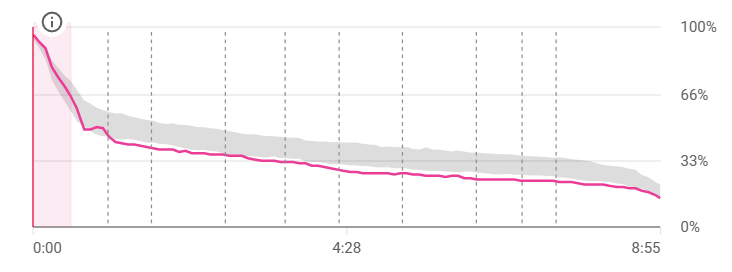
The first is a nine-minute video. The line falls from 100% to under half inside the first thirty seconds. From there it slides gently, a little below the grey band YouTube calls typical performance, all the way to the end. Nothing after the opening is broken. The middle holds. The ending holds. The video lost its audience before the first sentence was finished.
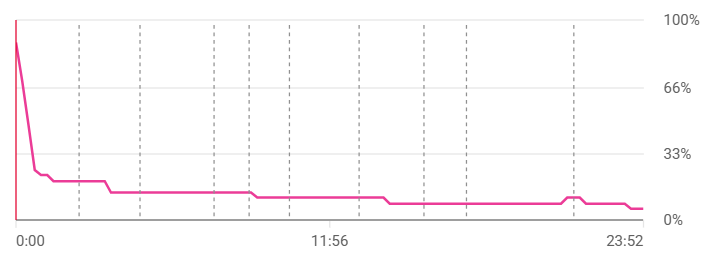
The second is a 24-minute video. The drop is steeper: about three quarters of viewers gone inside the first minute. Then the line goes almost flat for 23 minutes. Read that again. The viewers who got past the first minute watched nearly the whole thing. A quarter of the audience stayed for a 24-minute video. That is not a length problem. That is a video with a strong body and a first minute that told most people this was not for them.
What the shape is telling you
A retention curve has two parts and they answer two different questions. The first part, usually the first thirty to sixty seconds, is the hook. It answers: did the video deliver what the title and thumbnail promised, and did it do it fast enough? The second part, everything after the curve first flattens, is the body. It answers: once someone decided to stay, did the video keep its word?
Both curves above pass the second test and fail the first. The flat section is the proof. People who stay through the opening stay. So the fix is not in the script’s structure, the pacing of the middle, the music or the length. The fix is in the opening, and the opening alone.
Why the first minute fails
On a faceless channel the first minute fails in the same few ways. The video opens with an introduction instead of the claim. The narration spends twenty seconds telling the viewer what the video will cover instead of covering it. The visuals in the first ten seconds are generic stock footage that could belong to any video, so the eye has nothing to confirm the click. Or the title made a specific promise and the opening starts somewhere else, so the viewer concludes they clicked the wrong video and leaves.
None of those are fixed by cutting the video from 24 minutes to 12. The viewer who leaves at 0:40 never finds out how long the video was.
What to change
Rewrite the first sixty seconds of the next script before you touch anything else. Start on the claim the title made, in the first sentence, and prove it is this video. Put the most specific visual you have in the first ten seconds, the thing the thumbnail promised. Delete the summary of what is coming. Delete the greeting. If a number, a name or a result is the reason someone clicked, it is spoken in the first fifteen seconds, not saved for later.
Then leave the length alone. If the body of the curve is flat, the body is working. Make the next video the same length and judge the new opening on its own curve.
Go and do this
Open the retention report on your last three videos. For each one, note the time the curve first goes flat and the percentage it flattens at. If it is under a minute and under half, you have a first-minute problem on a video that otherwise works. Rewrite the opening of the next script to that standard. Do not cut a single minute from the end until the opening holds.